

How to Sell on Meesho in India (2026) — The Honest, Complete Guide
Meesho Seller Services
Key Takeaways
- Meesho's edge is value-priced, unbranded goods for tier-2/3 India — fashion, home, kitchen and accessories do especially well.
- 0% commission is real — but not zero cost. Your true costs are shipping and returns, and returns are the one everyone underestimates.
- You can start without GST via an Enrolment ID — intra-state only, within turnover limits, permitted categories.
- Price every product for a returns buffer — assume roughly 1 in 5 comes back, especially in fashion.
- Catalogs (4–9 products) beat single listings, and complete attributes + honest images drive both ranking and lower returns.
- Meesho Ads went ROI-based in 2025–26 — you set a target return and the algorithm spends only if it can hit it. (Most guides still describe the old cost-per-click model.)
- You need a regular GSTIN to advertise — Enrolment-ID sellers can't run ads yet.
💡 Quick Answers
+| Question | Answer |
|---|---|
| Do I need GST to sell on Meesho? | No — not to start. Register with an Enrolment ID/UIN and sell within your own state. A regular GSTIN is needed to sell across states, run ads, or once you cross the turnover limit. |
| Is it really 0% commission? | Yes, on every category in 2026. But you still pay shipping, and you absorb returns — those are the real costs. |
| How much does it cost to register? | Nothing. Registration and listing are free. |
| When do I get paid? | On a 7-day cycle after delivery — including COD orders — into your own bank account. |
| What sells best? | Value-priced, unbranded fashion, home, kitchen and accessories. Premium/branded goods usually earn more on Amazon/Flipkart. |
| What's the catch? | Returns — especially in fashion. Price with a returns buffer or you'll lose money on paper-profitable orders. |
📑 Table of Contents
+- 1.Why Sell on Meesho in 2026
- 2.The 0% Commission Model, Honestly
- 3.What You Can — and Can't — Sell
- 4.Choosing What to Sell
- 5.How to Register (With & Without GST)
- 6.Selling Without GST: The Enrolment ID Route
- 7.Tax & Compliance as You Grow
- 8.The Real Cost of Selling on Meesho
- 9.Pricing Strategy on Meesho
- 10.Payments & Settlement
- 11.What Happens When You Get an Order
- 12.Catalogs, Listings & Images
- 13.How Discovery Works on Meesho
- 14.Meesho Ads in 2026
- 15.Your Quality Score & Penalties
- 16.Reducing Returns: The Playbook
- 17.Shipping, Logistics & Valmo
- 18.The Meesho Selling Calendar
- 19.Your First 90 Days
- 20.Scaling Past 90 Days
- 21.Meesho vs Amazon vs Flipkart
- 22.What Changed Recently (2026)
- 23.Common Mistakes to Avoid
- 24.Myth vs Fact
- 25.Is Meesho Profitable?
- 26.Frequently Asked Questions
- 27.Glossary
So you're thinking about selling on Meesho. Maybe a friend told you they make a few thousand a month selling kurtis from their living room. Maybe you already sell on Amazon or Flipkart and you keep hearing that Meesho takes zero commission. Or maybe you just have some stock, a phone, and the sense that this is where a huge chunk of India actually shops. Whatever brought you here — good instinct. Meesho is genuinely the lowest-barrier way to start selling online in India: register free in about ten minutes, and in many cases start without a GST number at all. No other big marketplace lets you do that.
But here's what most guides won't tell you, because they're written to make it sound effortless: zero commission is not zero cost. Meesho earns its money somewhere — shipping and ads, mostly — and understanding where is the difference between suppliers who quietly build a real income and suppliers who list fifty products, get a wave of orders, and then discover that returns just ate their whole month. I've written this to be the one guide you actually need — plain language, current for 2026 (Meesho is now a listed company, and its ads model changed in ways most articles still get wrong), and honest about who Meesho suits and who it doesn't. You don't need us to do any of this; you can absolutely set it up yourself, and this guide is written so you can.
1. Why Sell on Meesho in 2026
Meesho isn't a smaller Amazon — it's a different animal, and it suits some sellers beautifully and others badly. Let me give you both sides so you can decide before you invest a single hour.
Meesho is a strong fit if you sell value-priced, unbranded goods — kurtis, sarees, dresses, home décor, kitchenware, jewellery, accessories — to a price-first, brand-indifferent buyer. It shines for products in roughly the ₹150–₹800 range, where 0% commission genuinely changes the math versus a marketplace that takes 15–20% off the top, and for high-volume, low-margin lines where you win on units, not premium. Its buyers are overwhelmingly in tier-2 and tier-3 India — more than 19,000 PIN codes — and that's who's scrolling.
Meesho is a weaker fit if you sell premium or branded products (there's no A+ content, no brand store, no real brand-building surface), electronics or high-value/high-tax goods (these need GST and carry higher return/damage risk), or anything with fragile margins and a high return rate. A lot of experienced sellers don't choose — they run both: Meesho for volume on value lines, Amazon/Flipkart for premium SKUs.
2. What Actually Makes Meesho Different: The 0% Commission Model, De-Hyped
This is the headline, so let's be precise, because "0% commission" gets repeated in a way that's technically true and practically misleading.
What's true. Meesho does not take a cut of your sale price. On Amazon or Flipkart, a ₹500 sale might have ₹75–₹100 shaved off as a referral fee before you see anything. On Meesho, that specific deduction is zero, across every category — Meesho's own supplier portal says sellers keep the full profit from each order, minus shipping.
What it leaves out. Meesho is a large, now-public business, and it earns from suppliers two other ways instead of commission: shipping/logistics (you pay to get each order delivered — a large share of Meesho's supplier revenue) and ads (the optional advertising you buy to be seen).
3. What You Can — and Can't — Sell
Meesho is broad but not unlimited, and your category interacts directly with the GST question.
- Sells well (mostly open, including no-GST): women's, men's and kids' fashion, ethnic wear, home furnishing and décor, kitchen and dining, jewellery and fashion accessories, bags, beauty and grooming, handcrafted goods.
- Needs GST from day one (not on the Enrolment-ID route): electronics and accessories, branded goods, and other high-tax categories. Listing these under a non-GST account risks rejection or suspension.
- Not allowed at all: counterfeit/replica branded items, hazardous goods, anything illegal. Meesho is strict on counterfeits and borrowed imagery.
4. Choosing What to Sell on Meesho
Before you register, the biggest lever on whether you succeed is what you list. Four filters to run every product idea through:
- Demand meets low price. Meesho buyers want everyday value at prices that feel like a steal. If your product only makes sense at a premium, it's the wrong platform for it.
- Margin survives returns. Pick products where your cost is low enough that even after shipping and roughly one return in five, you keep a healthy slice.
- Return risk is manageable. Apparel returns more than hard goods (size/fit). If you're new, a home/kitchen/accessory line is a gentler place to learn than sized clothing.
- You can out-execute, not just undercut. Look for subcategories where listings have weak images, missing size charts or thin attributes — that's where a disciplined new seller wins without dropping into loss-making prices.
5. How to Register — With GST, and Without
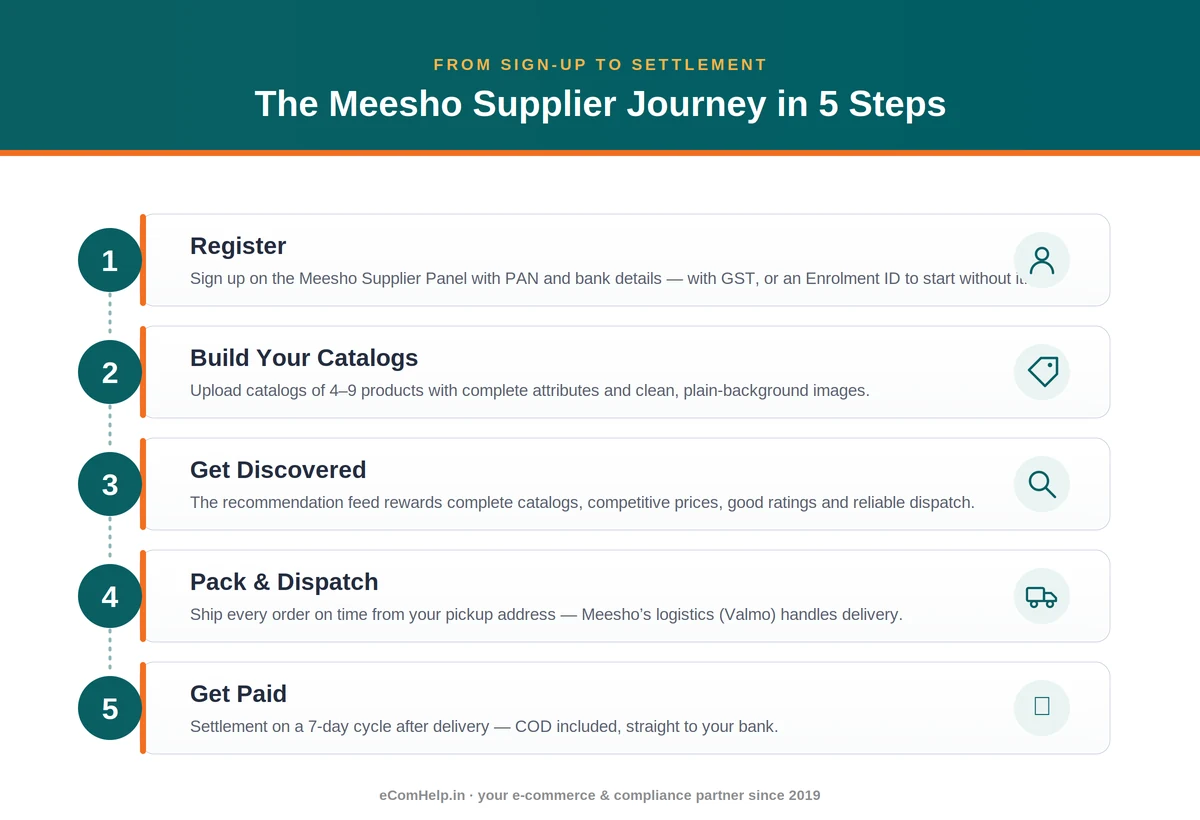
Registration is free and takes under ten minutes at the Meesho Supplier Panel (supplier.meesho.com). The one real decision is GST vs no-GST.
What you need either way: a bank account in your name (payouts land here, so the name must match your tax documents — Meesho verifies with a ₹1 test deposit); a PAN; a pickup address (home, shop or warehouse); a WhatsApp-linked mobile and email; and your product catalog.
The steps: sign up with mobile + OTP → choose GST (enter GSTIN, details auto-fill) or Non-GST (enter Enrolment ID/UIN) → add PAN + bank → set pickup address → name your shop → upload your first catalog. Listings usually go live within ~72 hours of verification.
Route A — With a GSTIN: unlocks the full platform — sell across all states, and run ads. If you're serious about scale, or sell branded/electronics/high-tax goods, register with GST from the start.
6. Selling Without GST: The Enrolment ID Route
Meesho lets eligible small sellers start without a regular GSTIN, using an Enrolment ID / UIN (a temporary number you generate on the GST portal) or a Composition GSTIN. This is Meesho's genuine, legal on-ramp for home sellers — unique among the big marketplaces. But read the conditions, because this is exactly where online guides go stale:
- Intra-state only. You may sell only within your registered state; interstate needs a regular GSTIN.
- Turnover cap. Operate under an Enrolment ID until annual sales cross ₹40 lakh (₹20 lakh in several NE/special-category states). A Composition GSTIN raises the ceiling to ₹1.5 crore (₹75 lakh in NE states).
- No GST on invoices. You can't charge or display GST on your prices.
- Category limits. Fine for many fashion, home, décor, jewellery and handcrafted lines; electronics, branded and high-tax items require GST.
- You can't run ads. Advertising currently needs a regular GSTIN — Enrolment-ID sellers can't advertise yet.
- It's a bridge, not a home. The Enrolment ID is temporary; as you grow, GST becomes mandatory. Plan the transition.
7. Tax and Compliance as You Grow
Starting without GST is fine — but plan for the compliance that arrives with growth, because it always does, and the sellers who plan for it never lose a day of selling to it.
- The GST trigger. The moment you cross the turnover cap, want to sell interstate, or want to run ads, you need a regular GSTIN. Register a little before you hit the wall so there's no gap in selling.
- Invoicing. On the no-GST route you invoice without GST. Once you have a GSTIN, invoices carry GST and your pricing math shifts — bake that in when you migrate.
- TCS. Marketplaces collect a small Tax Collected at Source on your sales against your PAN/GSTIN; you reconcile and claim it when you file. It's an advance you get back, not a cost — but track it.
- Keep clean records from day one. Settlement statements, dispatch photos, claim records. The seller who kept records breezes through scaling; the one who didn't spends weekends reconstructing them.
8. The Real Cost of Selling on Meesho
Here's the section that decides whether you make money. Since commission is zero, your costs are shipping and returns — and returns are the one nearly everyone underestimates.
Shipping. You pay a per-order charge based on the product's weight and delivery zone (local, regional, national — further costs more). Meesho's logistics — increasingly its own arm, Valmo, alongside third-party couriers — handles pickup and delivery. Heavier/bulkier items cost more, and light-but-large items can carry a volumetric weight. Slabs change, so always check current rates in your supplier panel before you price.
Returns and RTO — the honest math. Meesho is COD-heavy, value-shopping and fashion-heavy, and all three push returns up. Returns = the buyer sends it back (you eat reverse logistics, sometimes a damaged item). RTO = the order never delivers (refused/undeliverable/COD not honoured) and comes back with a logistics cost and no sale.
This is the single most important idea on this page: price every product as if roughly 1 in 5 will come back, especially in fashion (home and kitchen return less — a smaller buffer, but never zero). The 0% commission exists precisely to give you room to do that. Use it.
9. Pricing Strategy on Meesho
On a price-led, feed-driven platform, your price is not just a number — it's a ranking signal and a returns lever at the same time. Three things to get right:
- Price with the buffer, then to the converting band. Start from true cost (product + packing + shipping + a returns allowance), then use Meesho's Price Recommendation tool, which flags when your price has drifted above the band that's actually converting in your subcategory. Being 10% too expensive quietly drops you in the feed.
- Don't win by being cheapest — win by best value at a sustainable price. A race to the bottom is a race to selling at a loss once returns hit. Better images, a size chart and reliable dispatch let you hold a price a few rupees above the desperate sellers and still convert.
- Use discounts and combos deliberately. Combining products, or timing a discount into a sale event, lifts conversion and order value — far better than a permanent rock-bottom price that erodes margin every day.
10. Payments and Settlement
- Meesho pays you on a 7-day cycle after delivery — and crucially, this includes COD orders, a real relief on a COD-heavy platform.
- Payouts go directly to your own bank account. (If anyone helps you manage your account, your money still settles to you — never route payouts through a third party.)
- Claims. If an item comes back wrong or damaged, file a claim in the panel with QC evidence — photos and packaging proof captured at dispatch. Suppliers who document every dispatch win a meaningful share of these disputes back. Keep a quick photo of each packed parcel before handover.
11. What Actually Happens When You Get an Order
Here's the operational loop end to end, so nothing surprises you on day one:
- Order drops in. A notification hits the panel (and WhatsApp). Your dispatch SLA clock starts now.
- Accept and pack. Confirm, pack sturdily, and snap a quick photo of the packed, labelled parcel — the habit that pays for itself.
- Label and manifest. Meesho generates the shipping label; print and paste it.
- Handover. Meesho's logistics partner (often Valmo) collects from your pickup address. Hand over on time — late handover wrecks your dispatch metrics and ranking.
- Delivery — or return. The courier delivers; if refused or undeliverable it becomes an RTO and comes back.
- Settlement. Seven days after delivery — COD included — your payout (sale price minus shipping) lands in your bank. Damaged/wrong returns go through claims with your dispatch photos.
12. Catalogs, Listings and Images
Meesho doesn't really work in single "listings" — it works in catalogs, and understanding that is half the battle.
- A catalog is a group of 4–9 related products uploaded together (one kurti design across colours/sizes). Catalogs consistently earn more impressions than single listings — the recommendation engine favours them. Don't upload one product at a time.
- Bulk upload via spreadsheet handles larger ranges. Keep a clean master sheet; it makes re-pricing and restocking painless.
- Attributes matter enormously. Fabric, size set, colour, occasion, category — fill every field accurately. Incomplete attributes bury you in the feed and cause returns (wrong size = send-back).
- Image rules are strict and enforced. Real photos of the actual product, plain backgrounds, no watermarks, no text overlays, and no borrowed/stock images (a common takedown trigger). For apparel, include a clear size chart image — the single highest-leverage thing you can do to cut fashion returns.
13. How Discovery Actually Works on Meesho
This trips up sellers coming from Amazon. Amazon is search-first — buyers type what they want. Meesho is far more of a recommendation feed — buyers scroll, and the algorithm decides what to put in front of them. You don't "win a keyword." You earn feed placement by being what the algorithm wants to show.
The levers that drive Meesho visibility, in rough order of impact:
- Catalog completeness and image quality — the algorithm can only rank what it understands.
- Competitive pricing — on a price-first platform, price is a ranking factor; the panel's price tool exists for this.
- Dispatch reliability — ship on time, every time; late dispatch drops you.
- Ratings and low returns — happy buyers and low send-backs compound into more visibility.
14. Meesho Ads in 2026 — The Part Most Guides Get Wrong
Pay real attention here, because almost every article ranking for "Meesho ads" describes a model Meesho has moved away from.
The old model (still described everywhere): a simple cost-per-click system — set a daily budget, pay a few rupees per click/engagement, ads appear as "Ad"-tagged catalogs. You'll still see click-charged mechanics in parts of the panel, so it hasn't fully vanished.
The 2026 direction (what's actually new): Meesho has shifted toward a performance-led, ROI-based system driven by AI. Instead of bidding on clicks, you tell Meesho the minimum return you want on your ad spend, and its algorithm decides whether it can hit that — and only spends if it can. In the company's own words: if you want a 10× return on ₹100, Meesho spends that ₹100 only if it sees a clear path to ₹1,000 in incremental sales; if not, it doesn't spend. That's a genuinely seller-friendlier model, and almost nobody's "how-to" content reflects it yet.
- Ads come out of your payouts — you don't pay upfront; the used budget is recovered from what Meesho owes you.
- You need a regular GSTIN to advertise — Enrolment-ID sellers can't yet.
- Advertise winners, not everything. Let a new catalog run organically for a week; put ad money only behind catalogs already converting.
- Cap spend to your margins — around 2–5% of revenue, not the 10–15% you might spend on a higher-margin marketplace.
- Concentrate into event weeks. Budget spent during sale events (like the Maha Indian Shopping League and the festive stretch) converts far harder than an always-on drip.
- Watch ROI, not vanity. Impressions and clicks feel good; orders and return-on-spend pay the bills.
15. Your Quality Score, Dispatch and Penalties
Meesho watches how you perform and rewards reliability with visibility. The metrics that decide your standing:
- On-time dispatch — ship within the SLA. Late dispatch is the fastest way to lose ranking, and repeated misses can trigger penalties.
- Return and cancellation rate — high returns/cancellations hurt both margin and score.
- Ratings and quality complaints — your Quality dashboard breaks return reasons down by catalog, separating size complaints (fixable with a chart) from quality complaints (fix the product or supplier).
16. Reducing Returns — The Playbook
Since returns are the number-one thing standing between you and profit, they deserve their own plan. You can't eliminate them, but you can meaningfully lower them:
- Fix sizing first. In apparel, wrong size is the biggest single return reason. Add a clear, accurate size chart image to every catalog and put exact measurements in attributes. This one habit moves the needle most.
- Make images honest, not flattering. Photograph the actual product in true colour on a plain background. Returns spike when the item looks different in hand.
- Complete every attribute. The more the buyer knows, the fewer "not what I expected" returns.
- Package properly. Damage-in-transit returns are pure loss; sturdy packing pays for itself.
- Read the Quality dashboard monthly. It literally tells you why each catalog is coming back — fix the chart or the product; don't guess.
- Document dispatches for claims. Your dispatch photos are what win damage/wrong-return claims.
17. Shipping, Logistics and Valmo
Meesho fulfils orders through its logistics network — increasingly its own arm, Valmo, alongside third-party couriers. You pack the order; the courier picks it up from your registered pickup address and delivers it. There's no Amazon-FBA-style "send us your stock" model at the centre of Meesho — you hold your own inventory and dispatch per order. That keeps upfront cost low (no warehousing fees, no inventory locked away) but puts the dispatch discipline on you: pack fast, hand over on time, keep your metrics clean. Weight and zone decide the shipping charge; confirm current slabs in the panel before pricing.
18. The Meesho Selling Calendar
Meesho's demand is seasonal and event-driven far more than Amazon's steadier baseline, and suppliers who plan around the calendar capture a disproportionate share of the year's volume.
- Jan–Mar (lean quarter): build catalog depth, improve images and size charts, and climb the rankings while competition is quieter and cheaper to out-rank.
- By July: lock in bestseller inventory for the festive run — don't be sourcing in September.
- Aug–Dec (festive stretch + sale events): most of the year's volume. Enter it with stock committed, ad budget ready, and NDD enrolment already in place — sale-event participation needs healthy dispatch metrics in advance.
19. Your First 90 Days on Meesho
- Weeks 1–2: Register, build 2–3 strong catalogs (4–9 products each), nail images, size charts and attributes, and set prices with a returns buffer.
- Weeks 3–4: Go live. Ship every order on time and obsess over dispatch SLA. Start photographing every dispatch for future claims.
- Weeks 5–8: Read your Quality dashboard. Fix what's driving returns (size charts, honest images, or a product swap). Use the price tool to stay in the converting band.
- Weeks 9–12: Identify your 2–3 converting catalogs. Now — if you have a GSTIN — put a small, capped ad budget behind those winners, and start building toward the festive calendar.
20. Scaling Past Your First 90 Days
Once you've got a few converting catalogs and clean metrics, growth on Meesho is mostly about repeating what works — deliberately:
- Deepen before you widen. Add more designs/variants to catalogs that already convert before jumping to new categories — the algorithm already trusts them.
- Layer ads onto winners. With a GSTIN and proven catalogs, put a capped, ROI-targeted budget behind your best performers and scale only as the return holds.
- Earn NDD and event slots. Stable dispatch metrics unlock Next Day Dispatch and sale-event participation — two of the cheapest visibility multipliers.
- Go interstate. If you started intra-state on an Enrolment ID and demand is there, a regular GSTIN opens the whole country — often the single biggest step-change available.
- Try content commerce. Meesho's influencer program lets creators earn commission on sales they drive; a few well-matched creators can move a bestseller without you touching an ad dashboard.
21. Meesho vs Amazon vs Flipkart — Which Is Right for You?
| Meesho | Amazon / Flipkart | |
|---|---|---|
| Best for | Value-priced, unbranded, high-volume goods | Premium and branded products |
| Commission | 0% (pay shipping + returns instead) | Referral/commission fees apply |
| GST to start | Optional (Enrolment ID, intra-state) | Effectively required |
| Brand-building | Minimal (no A+ / brand store) | A+ content, brand stores, registry |
| Buyer | Price-first, tier-2/3, COD-heavy | Broader, higher average order value |
| Discovery | Recommendation feed | Search-first |
| Main risk | Returns / thin margins | Fees eat low-price items |
22. What Changed Recently on Meesho (2026)
Because most content online is stale, here's what's genuinely current — and worth being the person who knows it:
- Meesho is now public. It IPO'd in December 2025 — bringing more scrutiny, more investment, and a sharper focus on making suppliers profitable, not just numerous.
- Ads went ROI-based. The shift from cost-per-click toward a performance-led, AI-driven "tell us your target return" model is the single biggest change most guides miss.
- Logistics is consolidating around Valmo, Meesho's own delivery arm, alongside third-party couriers — worth watching as shipping economics evolve.
- Content commerce is rising. Meesho now lets sellers work with influencers who earn commission on sales they drive across Meesho, Instagram and YouTube — a growing, low-cost visibility lever.
- GST rules keep shifting. The no-GST Enrolment-ID route is current as of 2026, but GST policy is fluid — always confirm the live position in the panel and on the GST portal before relying on it.
23. Common Mistakes to Avoid
- Pricing with no returns buffer. The #1 Meesho killer. Assume ~1 in 5 comes back.
- Uploading single products instead of catalogs. You're leaving impressions on the table.
- Weak or borrowed images. Takedowns, poor conversion and higher returns, all at once.
- No size chart. In fashion, this is half your returns walking out the door.
- Ignoring the Quality dashboard. It tells you exactly why you're getting returns — read it monthly.
- Advertising everything from day one. Advertise proven catalogs only, and only with a GSTIN.
- Listing right before the festive season. Too late for the ranking ramp; build in the lean months.
- Treating "0% commission" as "0% cost." Shipping and returns are your real costs.
- Not documenting dispatches. You forfeit winnable damage/wrong-return claims.
- Wrong-category listing under a non-GST account. Electronics/branded need GST — this gets accounts suspended.
24. Myth vs Fact
| # | Myth | Fact |
|---|---|---|
| 1 | "Meesho is completely free, so it's pure profit." | Commission is 0%, but shipping and returns are real costs that decide your margin. |
| 2 | "You can never sell on Meesho without GST." | You can start via an Enrolment ID — intra-state, within turnover limits, permitted categories only. |
| 3 | "Meesho Ads are just cost-per-click." | Meesho moved toward a ROI-based, AI-driven ad model in 2025–26 — you set a target return. |
| 4 | "Anyone can run ads." | Advertising needs a regular GSTIN — Enrolment-ID sellers can't yet. |
| 5 | "List a few products and orders flood in." | Catalogs, complete attributes, competitive price and reliable dispatch drive the feed — it's earned. |
| 6 | "Returns are rare." | On a COD, value-fashion platform, returns/RTO are the biggest cost — price for them. |
| 7 | "Meesho is only for tiny home sellers." | It's the volume play for value goods; plenty of suppliers scale seriously — it's now a listed company. |
| 8 | "Cheapest price always wins." | Too-cheap loses money after returns and can hurt ranking; best value at a sustainable price wins. |
25. So — Is Selling on Meesho Profitable?
Honestly? It can be, and it can also quietly lose you money — and the deciding factor is usually returns, not commission. If you sell value-priced goods, price with a returns buffer, keep dispatch reliable, cut returns with size charts and honest images, and lean into the festive calendar, Meesho is one of the best low-risk ways to build online sales volume in India. If you sell premium or branded products, or price without accounting for returns, it'll disappoint you. The platform rewards discipline, not hype — which, if you're the disciplined type, is very good news for you.
26. Frequently Asked Questions
Launch & Grow on Meesho with eComHelp
We help suppliers across India get live on Meesho and run their accounts the right way — registration (with or without GST), catalog creation, images, pricing, discovery and ROI-based ads, handled end to end. Transparent fixed pricing. Because Meesho has no sub-user login, we're upfront about account access: your payouts always go to your own bank, and you can revoke our access any time.
Sell on Meesho — With a Team That's Done It Before
Registration, catalogs, images, pricing, discovery and ROI-based ads — handled end to end. Transparent fixed pricing, and we're upfront about account access: your payouts always go to your own bank, and you can revoke our access any time.
Talk to Us on WhatsApp →📚 References
+For readers who want to verify the details in this guide, here are the source areas. Figures are current as of July 2026 and are subject to change by Meesho and by government notification — always confirm your exact position in your own Meesho Supplier Panel.
- Meesho Supplier Portal — registration flow, non-GST / Enrolment-ID terms, the 0% commission policy, ads and shipping documentation (supplier.meesho.com)
- Meesho Ads — the move to a performance-led, ROI-based ad model (2025–26), reported via Storyboard18 and Meesho's supplier ads pages
- GST portal / CBIC — Enrolment ID / UIN and Composition scheme rules for e-commerce sellers, and intra-state selling conditions
- Meesho 2026 seller guides — cross-verification of settlement cycle, catalog rules, returns economics and the Valmo logistics rollout
- Meesho IPO (December 2025) — platform scale and post-listing context