

How to Sell on Flipkart in India (2026) — The Complete Seller Guide
Flipkart Seller Services
Key Takeaways
- Flipkart's edge is value-priced, mass-market goods for non-metro India — fashion, home, kitchen and electronics accessories do especially well.
- GST is mandatory from the first sale for taxable goods; sort it before you register, because it gates everything.
- The November 2025 Zero Commission Model waived commission on all products under ₹1,000 — your economics in 2026 are genuinely better than older guides suggest.
- Reliability is the whole game. On-time dispatch, low cancellations and low returns drive your seller tier, your visibility and the F-Assured badge.
- Listings rank on relevance and performance — keywords and complete attributes get you found; clicks, conversions and ratings keep you ranked.
- Ads only pay once your listing converts — fix images, price and reviews first, then advertise.
- If you use FBF across states, you may need multi-state GST registration — a detail many sellers miss until it bites.
💡 Quick Answers
+| Question | Answer |
|---|---|
| Do I need GST to sell on Flipkart? | Yes, for taxable goods — and from your very first sale. The usual ₹20–40 lakh thresholds don't apply to marketplace sellers. The only exception is selling exclusively GST-exempt goods (like books). |
| How much does Flipkart charge sellers? | Four fees per order — commission (2–25% by category), a fixed closing fee, shipping, and a collection fee — plus 18% GST on those fees and 1% TCS. Since Nov 2025, commission is zero on products under ₹1,000. |
| Is Flipkart free to join? | Yes — no registration fee and no monthly subscription. You only pay per sale. |
| How long does registration take? | Typically 3–7 working days once documents are verified. Restricted categories take longer. |
| When do I get paid? | Gold/Platinum sellers around 5 business days after dispatch, Bronze/Silver around 7–10 days. Payouts run Monday, Wednesday and Friday. |
| FBF or self-ship? | FBF gives faster delivery, the F-Assured badge and better visibility, for a fee. Self-ship keeps control and avoids storage costs but puts delivery reliability on you. |
📑 Table of Contents
+- 1.Why Sell on Flipkart in 2026
- 2.What Is the Flipkart Seller Hub?
- 3.What You Need Before You Start
- 4.How to Register: Step by Step
- 5.GST Rules for Flipkart Sellers
- 6.Listing Your Products
- 7.Listing Optimization
- 8.Brand Approval & Category Gating
- 9.Fulfilment: FBF vs Smart vs Self-Ship
- 10.The F-Assured Badge
- 11.Flipkart Fees Explained (2026)
- 12.Work Out Your Profit
- 13.Flipkart Advertising
- 14.How & When You Get Paid
- 15.Seller Tiers
- 16.Account Health & Seller Protection
- 17.Big Billion Days & Sale Events
- 18.Category-Specific Guidance
- 19.Flipkart vs Amazon
- 20.Common Mistakes to Avoid
- 21.Myth vs Fact
- 22.Your First Year: A Roadmap
- 23.Frequently Asked Questions
- 24.Glossary
So you're thinking about selling on Flipkart. Maybe you're just getting started online, maybe you already sell on Amazon and you're wondering whether a second marketplace is really worth the effort, maybe someone told you your product would do well there. Whatever brought you here — chances are you're right to be looking. Flipkart is India's largest homegrown marketplace, and in 2026 it reaches more than 45 crore shoppers, a lot of them in the tier-2 and tier-3 towns where online shopping is growing the fastest. If you make or source something for the everyday Indian buyer, that's your crowd.
I've written this to be the one guide you actually need — the whole thing, start to finish, in plain language, with no jargon and no assuming you already know how any of it works. We'll go through how to register, what documents and GST you genuinely need (and exactly where people trip up), how the fees really work after Flipkart's big November 2025 shake-up — because, honestly, most guides out there are still quoting the old numbers — your fulfilment choices, how to actually get your listings found, how advertising works, and how to keep your account healthy. By the end you'll understand how selling on Flipkart really works in 2026 — the costs, the rules, the choices — well enough to start. And if you'd rather we just handled it for you, that option's here too. But you don't need us to follow this. You can absolutely do this yourself.
1. Why Sell on Flipkart in 2026
Let me give you both sides — where Flipkart genuinely shines, and where it doesn't — so you can decide with your eyes open.
Flipkart's real strength is its reach into non-metro India. A large share of its orders come from smaller cities and towns — the "next India" coming online now — and Ekart, its logistics arm, delivers into places where other networks are thinner. In 2025 Flipkart handled an estimated ₹80,000+ crore in gross merchandise value, and for sellers in fashion, footwear, home furnishings and consumer-electronics accessories, it often beats other platforms on sales velocity. If your product is priced for value and made for the mass Indian market, Flipkart's audience is a natural fit.
Two things make 2026 a good moment. First, the November 2025 fee overhaul (details below) meaningfully improved the economics for affordable products. Second, Flipkart has been actively lowering the barrier for first-time sellers — simpler onboarding, clearer pricing, and financing tools like ad-credit.
The caveat: Flipkart is India-only and highly price-sensitive. It rewards competitive pricing and reliable fulfilment more than premium branding. So it suits sellers who can compete on value and deliver consistently.
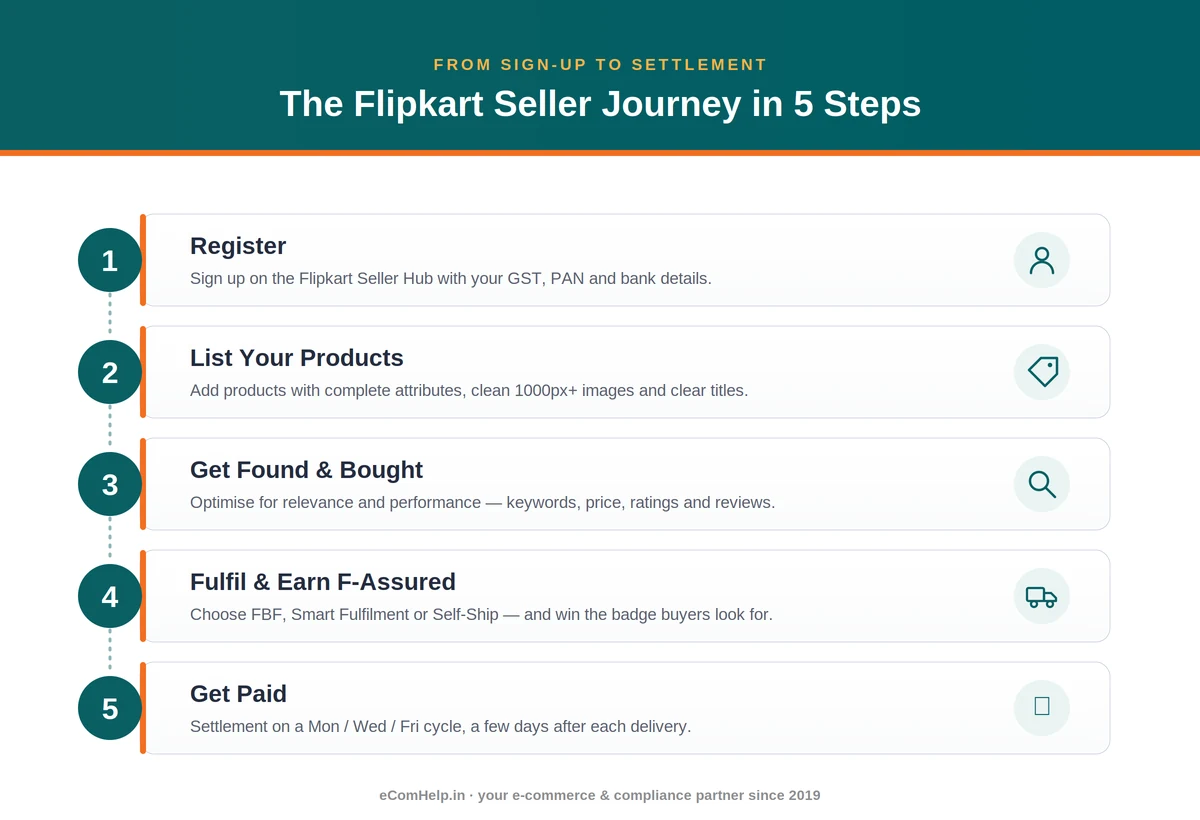
2. What Is the Flipkart Seller Hub?
The Flipkart Seller Hub (seller.flipkart.com) is your control room. It's a single seller account — unlike Amazon's two-tier plan structure, Flipkart uses one account model with category-based commission and no monthly subscription fee, which lowers your fixed cost of getting started.
From the Seller Hub you manage everything: product listings and catalogue, inventory, orders, returns, payments and settlements, advertising campaigns, and your performance dashboard. It's also where you add team members through Manage Users — you can invite people (like an agency) with their own login and a defined role, without ever sharing your password.
3. What You Need Before You Start
Get these ready before you register — it turns registration into a same-sitting job instead of a stop-start one:
- GSTIN — required for taxable goods (see section 5 for the one exception).
- PAN — of the business or individual proprietor.
- A bank account in the business's name, for settlements.
- Business details — registered name and pickup/business address.
- Signature / stamp — for the seller agreement.
- At least one product ready to list — with details, images and pricing. You need one live listing to finish onboarding; there's no large minimum, though a fuller catalogue helps you gain traction faster.
- A registered mobile number and email — for OTP verification.
- Category-specific documents if you sell in a gated category (brand authorisation, FSSAI licence for food, etc. — see section 8).
4. How to Register as a Flipkart Seller: Step by Step
Registration happens on the Flipkart Seller Hub. The flow:
- Sign up with your email and mobile number, and verify with the OTP.
- Enter your GSTIN and PAN — Flipkart uses these to verify your business.
- Add your pickup address — where your inventory ships from.
- List at least one product — you need one live listing to complete onboarding. List against an existing catalogue entry or create a new one.
- Enter your bank account details for settlements.
- Complete your profile and sign the agreement — including your signature/stamp where asked.
- Go live — once verified, your listings become active and you can receive orders.
How long does it take? Usually 3–7 working days for standard categories once your documents check out. It takes longer if brand or category approvals are involved — so if your products fall in a restricted category, start that approval during registration to avoid delays.
5. GST Rules for Flipkart Sellers
This is where new sellers most often get tripped up, so let's be precise.
GST registration is mandatory to sell taxable goods on Flipkart — from your very first sale. Here's the part that surprises people: the usual turnover thresholds (₹40 lakh for goods, ₹20 lakh for services) do not apply to marketplace sellers. Under Section 24(ix) of the CGST Act, anyone supplying taxable goods through an e-commerce operator must register regardless of turnover. Flipkart needs your GSTIN to activate your account.
The one exception: if you deal exclusively in GST-exempt goods — for example, books, certain unbranded/unprocessed foods, and some handicrafts — you can register and sell without a GSTIN, declaring this during sign-up. The catch is exclusivity: a single taxable product in your catalogue reinstates the full GST requirement, which locks most sellers out of this route (clothing, electronics and the like are all taxable).
Two more things: Flipkart deducts 1% TCS (Tax Collected at Source) on your net taxable sales and deposits it with the government — it's not an extra tax, it's a credit you reconcile and claim at return-filing. And don't register under the Composition Scheme if you plan to sell on Flipkart; marketplace sellers need regular registration.
If you don't have GST yet — or need multi-state registrations for FBF — that's a solvable first step, and one of the services we handle. Sort it before you register, because it gates everything else.
6. Listing Your Products on Flipkart
A listing is your storefront — title, images, price, description and attributes — and on a platform with 150 million+ live listings, how well you list decides whether you're ever seen.
Creating listings. Add products one at a time, or in bulk via catalogue uploads for larger inventories. Flipkart often works on a shared-catalogue model: you either list against an existing product entry or create a new one. For each listing you'll set the MRP, your selling price, stock quantity, title, description and the mandatory attributes for that category (colour, size, material, and so on).
Quality Check (QC). Every new listing goes through Flipkart's QC review — typically 24–72 hours — before it goes live. Listings get rejected for poor-quality images, wrong category, misleading content, missing certificates, fake/inflated MRP, duplicate listings, or incomplete attributes. Getting it right the first time saves days.
Image rules that actually matter. Use clear, high-resolution images (at least 1000×1000 px so buyers can zoom), on clean white backgrounds, with no watermarks or text. Upload 5–7 images showing front, back, sides and close-up detail. For fashion, an accurate size chart is effectively mandatory — it's both a ranking/approval factor and the single biggest lever on returns.
Attributes are not optional. Flipkart's search filters punish missing attributes harder than most marketplaces. Every empty attribute field is a search you don't show up in — filling all of them is one of the highest-return, lowest-effort things you can do.
7. Listing Optimization: Getting Found and Getting Bought
Optimization isn't a one-time setup — it's the ongoing work of ranking higher as the marketplace shifts. To do it well, know what Flipkart's algorithm measures: it ranks on two things — relevance and performance.
Relevance — do you match the search?
- Keywords in your title and description. The proven title format is [Brand] + [Material/Key Attribute] + [Product Type] + [Colour/Size] — clean, factual, front-loaded with the words buyers type. Avoid all-caps, symbols and misleading claims.
- Attributes — category, brand, size, colour, specifications. Complete, accurate attributes are how filters find you.
- How closely your listing matches the actual query.
Performance — do buyers respond?
- Click-through rate from search (your main image and price do most of the work).
- Conversion rate from visit to purchase.
- Ratings and review volume — products with 4.0+ ratings and 20+ reviews rank noticeably higher, and the first genuine reviews on a new listing matter most.
- Price competitiveness against similar listings on the same search page.
- Stock availability and fulfilment consistency — running out or dispatching late quietly kills your ranking.
A note on enhanced content: Flipkart doesn't offer a standard A+ Content equivalent for every seller the way Amazon does — richer content is generally limited to approved brands. For most sellers, the fundamentals above are the optimization.
8. Brand Approval, Trademark & Category Gating
Two gates can stand between you and a live listing: brand approval and category approval. Sort both early — they're the most common first-week roadblocks.
Brand approval. To list branded products, Flipkart verifies you're authorised to sell that brand — whether you're the brand owner or an authorised reseller. You'll typically need a trademark (if it's your brand) or a brand-authorisation letter (if you're reselling). "Gated" brands carry stricter documentation and may sit inside premium brand programs. Most approval delays come from documentation gaps or the wrong authorisation format, so get the paperwork right the first time. If you own your brand, registering a trademark unlocks approval and gives you far more control over your listings.
Can you sell without a brand/trademark? Yes — unbranded/generic products can be listed in many categories, and you compete on quality listings, reviews and service instead. But a registered brand gives protection and credibility that compound over time.
Category gating. Most standard categories — fashion, home decor, sports, books, stationery, household goods — are open immediately once your account is approved. But several need extra authorisation before you can list, for example:
- Consumer electronics and mobiles
- Precious jewellery
- Health supplements and ayurvedic/herbal products (need FSSAI licensing for consumables)
- Packaged food and spices (FSSAI registration)
- Liquor and other regulated goods
If your product sits in a gated category, apply for approval during registration so it doesn't stall your launch — especially for FSSAI-dependent categories.
9. Fulfilment: FBF vs Smart Fulfilment vs Self-Ship
How you fulfil orders shapes your costs, your delivery speed, and whether you earn the conversion-lifting F-Assured badge. Flipkart gives you three main routes.
| Option | How it works | Best for |
|---|---|---|
| Flipkart Fulfilment (FBF) | You send stock to Flipkart's warehouses; Flipkart stores, packs, ships and handles returns. Lower fixed fee per order; easiest path to F-Assured. (Amazon's FBA equivalent.) | High-velocity, small, lightweight SKUs with steady demand |
| Smart Fulfilment | Your stock stays in your warehouse, with Flipkart's tech and standards layered on — F-Assured-eligible, express dispatch, no full hand-over. Invite-only. | Sellers wanting F-Assured benefits while keeping their inventory |
| Self-Ship (with Ekart) | You store and pack; Ekart picks up and delivers. Most control, no storage fees, but reliability is on you and the fixed fee is higher. | Larger/heavier items, custom products, or early testing |
Many sellers blend the two managed options — slow movers at home under Smart Fulfilment, fast movers in FBF.
10. The F-Assured Badge
F-Assured is a trust badge on listings that clear Flipkart's quality-and-speed bar. It signals fast delivery (typically 2–4 business days) and reliable service, and it visibly lifts conversion because buyers trust it.
Products are assessed on roughly six things: packaging, product specifications, product ratings, return rate, your ability to fulfil the order, and adherence to promised delivery timelines (with real-time tracking). It's easiest to earn through FBF, but not exclusive to it — Smart Fulfilment or consistently strong self-fulfilment metrics can also qualify you.
11. Flipkart Fees Explained (2026)
Most guides get this wrong, because Flipkart overhauled its fees in November 2025 and older articles still quote the old numbers. Here's the current, verified picture. Flipkart deducts four separate charges per order, then adds 18% GST on top of all of them:
| Fee | What it is | Typical range |
|---|---|---|
| Commission (referral) | % of your selling price, varies by category | ~2–25% (mobiles low, fashion high; most 5–17%). ₹0 under ₹1,000 since Nov 2025 |
| Fixed / closing fee | Flat per delivered order, by price slab & seller tier. Lower on FBF; not charged on returns | Varies by slab & tier |
| Shipping | By weight (actual or volumetric L×W×H÷5000) and zone (local/zonal/national) | Free for most sub-500g local/zonal (Nov 2025) |
| Collection fee | Payment processing, on full order value | ~2% prepaid / ~2.5% COD |
On top of these four, 18% GST applies to the total fees (input-creditable if GST-registered), and Flipkart deducts 1% TCS, reclaimable at return-filing.
The big 2025 change: the Zero Commission Model
On 14 November 2025, Flipkart introduced a Zero Commission Model — the commission fee is waived entirely on all products priced under ₹1,000. (Previously it applied only to select categories and products under ₹500.) On Shopsy, Flipkart's hypervalue platform, commission is now zero on all products regardless of price. Flipkart also reduced return fees and made local/zonal shipping free for most categories on products under 500g — together cutting the cost of doing business by up to 30% for sellers under ₹1,000.
Don't confuse Flipkart's commission with the GST on your product (the tax the customer pays, by HSN code — 0/5/12/18/28%). The four fees are the platform's charges; product GST is a separate tax you collect and remit.
12. Work Out Your Profit Before You List
The most common way sellers lose money is pricing without modelling the full fee load — "profitable" on paper, broke at settlement. Do the maths before you list.
A worked example (illustrative). A ₹1,499 home product, self-shipped, prepaid, delivered nationally, as a Gold-tier seller. Because it's over ₹1,000, commission applies:
- Commission (~11% for home) ≈ ₹165
- Fixed / closing fee ≈ ₹30–40
- National shipping (~1 kg) ≈ ₹60–75
- Collection fee (2% prepaid) ≈ ₹30
- 18% GST on those fees ≈ ₹53
- Total deductions ≈ ₹340 — about 23% of the selling price, before your product cost.
Now take the same product at ₹899 (under ₹1,000): commission drops to ₹0 under the Zero Commission Model. You'd pay only the fixed fee, shipping, collection fee and GST — a materially smaller bite. That's the 2025 change working for you.
13. Flipkart Advertising: Getting Seen
Once you're live and your listings convert, ads are how you get discovered on a platform this crowded. Flipkart runs its own ad system through the Flipkart Ads Centre, reaching 45 crore+ users — and it works differently from Amazon's.
The three ad types
- Product Listing Ads (PLA) — the workhorse. Your product appears in sponsored slots across search, browse, home and product pages (six placement types), on a cost-per-click (CPC) model — you pay only when someone clicks. Up to 2,000 products per campaign; keyword targeting via exact and phrase match (plus up to 200 negative keywords).
- Product Contextual Ads (PCA) — placements on product and related pages, for visibility and cross-sell. Daily or total budget.
- Display Ads — broader brand-visibility placements.
Two campaign styles within PLA
- CPC campaigns — you bid for visibility. Best for newly launched or low-visibility products.
- SmartROI campaigns — you set a target ROI and Flipkart's machine learning manages bids to hit it. Best for products that already have visibility and sales. Quirk: set the target ROI too high and the system simply won't spend — it's a lever to tune, not set-and-forget. Sellers only (not vendors).
Metrics you'll live by: ROI/ROAS, CTR, CPC, and conversions (Flipkart splits direct vs indirect), with FSN-, placement- and keyword-level reports updated roughly every 24 hours. There's no single "ACoS" label, but ROI/ROAS plays the same role.
The bottom line Flipkart itself states: no one can guarantee a sale from ads — it depends on your listing quality, stock, pricing and reviews. Ads amplify a good listing; they can't rescue a bad one.
14. How and When You Get Paid
Flipkart releases payments on Monday, Wednesday and Friday, triggered after dispatch and the return window. Speed depends on your seller tier:
- Gold / Platinum sellers: paid roughly 5 business days after dispatch.
- Bronze / Silver sellers: roughly 7–10 business days after dispatch.
Plan your working capital around this gap — the wait between making a sale and seeing the money is a common cash-flow squeeze for newer sellers. Two levers help: climbing seller tiers (faster settlement) and encouraging prepaid orders (COD adds friction and cost). Reconcile the 1% TCS shown in your GSTR-2A/2B against what Flipkart deposited, so you claim the credit correctly.
15. Seller Tiers: How Flipkart Rewards Performance
Every seller starts at Bronze and can climb through Silver → Gold → Platinum, on a rolling assessment of sales volume, on-time dispatch, cancellations, returns and ratings. It's the closest thing Flipkart has to Amazon's STEP program, and it isn't cosmetic — your tier drives real money:
- Lower fixed fee per order at higher tiers (this compounds fast at volume).
- Faster settlements (≈5 days vs 7–10).
- Better visibility weighting in search for equivalent listings.
- Dedicated account support and early access to sale events at the top tiers.
16. Account Health & Seller Protection
Flipkart tracks your performance closely, and it directly affects your visibility, your F-Assured eligibility, your tier, and — in serious cases — whether your account stays active. The metrics that matter most:
- Cancellation rate — orders you cancel after they're placed. One of the most damaging metrics of all.
- Ready-to-Dispatch (RTD) breach rate — missing dispatch deadlines. Watched closely: fulfilment-enhancement programs look for an RTD breach rate under 1%.
- Return rate — high returns hurt both economics and standing (fashion runs structurally higher, so size charts and accurate images earn their keep).
- Customer ratings — products with 4.0+ ratings and 20+ reviews rank noticeably higher.
These roll up into your seller tier. The practical takeaway: reliability is the game on Flipkart. Ship on time, don't cancel, keep quality high, and everything downstream — tier, visibility, F-Assured, faster payment — follows. Slip, and no amount of advertising will save you.
17. Big Billion Days & Sale Events
You can't plan a Flipkart year without planning for Big Billion Days (BBD) — Flipkart's flagship mega-sale, held around October in the festive season. It's the platform's highest-GMV event by far, and some sellers report 15–30× their normal daily sales during peak days.
Winning BBD is about preparation, not luck:
- Inventory: on FBF, get stock into fulfilment centres before Flipkart's intake deadline (typically 6–8 weeks ahead). Running out mid-event is lost sales you can't recover.
- Deals: register through the Seller Hub's Deal Registration process 4–6 weeks before — Flipkart curates which deals get promotional slots.
- Pricing: event badges usually require a minimum discount (often 30–70% off MRP), so model your margins in advance.
- Listings: images, descriptions and size charts complete before the event — listing issues during BBD cost sales you can't win back.
- Ads: pace your budget for the peak evening hours; new sellers often exhaust budgets too early in the day.
New sellers should aim to be sale-eligible (healthy metrics, FBF or F-Assured stock) before the September–October festive window — it's the single biggest demand event of the year.
18. Category-Specific Guidance
Flipkart doesn't behave the same across categories — commission, returns and what wins differ enough that your strategy should flex by what you sell.
- Fashion & apparel — Flipkart's biggest strength, trickiest economics. Commission is high (often 15–25%) and returns run higher (fit/size). Winners obsess over accurate size charts, clean multi-angle images and honest descriptions. FBF speed helps.
- Mobiles & electronics accessories — low commission (2–8%) but thin margins and fierce competition. Brand approval and authenticity usually required. Volume and reliability win, not markup.
- Home & kitchen — moderate commission (~8–15%), deep tier-2/3 demand. Weight/zone drive your fee load, so lightweight packaging and bundling pay off.
- Beauty & personal care — moderate commission; reviews and authenticity are everything, and consumables need FSSAI compliance.
- FMCG, grocery & everyday goods — a lot sits under ₹1,000, so the Zero Commission Model helps most here. FSSAI applies to food; reliable stock and dispatch win.
- Books — one of the few GST-exempt entry points, with low commission and low returns. A common way to start, though a narrow lane.
Know your category's commission band and return profile before you price, and lean into the fulfilment and listing choices that category rewards.
19. Flipkart vs Amazon: The Honest Comparison
If you're choosing between them — or running both — here's the straight side-by-side.
| Flipkart | Amazon India | |
|---|---|---|
| Audience | Strongest in tier-2/3 India; value-focused | Broad; strong in metros, wider premium mix |
| Best categories | Fashion, home, mobile, electronics accessories | Electronics, premium, Prime-driven repeat buying |
| Account model | Single account, no monthly subscription | Individual vs Professional plans |
| Fees | Four fees + 18% GST; zero commission under ₹1,000 (Nov 2025) | Referral % by category + fulfilment fees |
| Fulfilment | FBF, Smart Fulfilment, Self-Ship (Ekart) | FBA, Easy Ship, Seller Flex |
| Reliability badge | F-Assured | Prime |
| Advertising | PLA / PCA / Display; CPC & SmartROI | Sponsored Products / Brands / Display |
| Rich content | Strong images + attributes; enhanced content for approved brands | A+ Content / Brand Registry |
| Performance tiers | Bronze → Silver → Gold → Platinum | STEP program |
| Account access | Manage Users — own login, no password sharing (Admin / Operations Manager) | User Permissions — own login, granular roles |
| Reach | India only | India + global marketplaces |
20. Common Mistakes New Flipkart Sellers Make
- Registering before GST is sorted — it gates everything (and plan multi-state registration if you'll use FBF across regions).
- Using old fee numbers — the Nov 2025 changes are significant; run current maths, not a 2024 blog's.
- Ignoring dispatch deadlines and cancellations — the fastest way to wreck a new account's tier and visibility.
- Advertising on weak listings — fix images, price and reviews before you spend a rupee.
- Skipping brand or category approval — then being unable to list, or stalling launch for weeks.
- Incomplete attributes — every blank field is a search you don't appear in.
- Underestimating the settlement gap — plan working capital for the 5–10 day wait.
- Treating F-Assured as permanent — it's earned continuously and can be lost.
- Winging Big Billion Days — missing intake and deal-registration deadlines means missing the biggest week of the year.
21. Myth vs Fact
| # | Myth | Fact |
|---|---|---|
| 1 | "Flipkart takes about 20% of every sale." | There's no single flat rate. It's four fees that stack differently by category, price, weight, zone and tier — and since Nov 2025, commission is zero under ₹1,000. Model your actual product. |
| 2 | "I only need GST once I cross ₹20–40 lakh turnover." | For marketplace sellers, the threshold doesn't apply — GST is required from your first taxable sale. |
| 3 | "FBF automatically gives every product the F-Assured badge." | No. The badge is per-product and performance-based (returns, ratings, fulfilment) — and it can be removed if performance slips. |
| 4 | "More ad spend means more sales." | Not if the listing doesn't convert. Flipkart's auction weights listing quality; ads amplify a good listing and waste money on a weak one. |
| 5 | "Once I optimise a listing, I'm done." | Ranking is a moving target — competitors update, trends shift, the algorithm re-weighs. Optimization is ongoing. |
| 6 | "Selling on Amazon means I already know Flipkart." | The fees, fulfilment programs and ad system all differ. The strategy transfers; the specifics don't. |
22. Your First Year on Flipkart: A Realistic Roadmap
A first year on Flipkart has a shape. Following it beats scrambling.
Months 1–3 — build the boring foundation. Register, sort GST, list 20–50 SKUs with complete attributes and clean images. Win the "buy box" on matched listings (a price-and-reliability formula), and above all stabilise your dispatch metrics. This unglamorous quarter decides everything later.
Months 4–6 — find and back your winners. Trim the catalogue to what converts. Move proven movers into FBF, start PLA on winners, and chase the F-Assured badge on your best listings.
Months 7–9 — prepare for the festive engine. Build inventory and cash for BBD, hit the FBF intake and deal-registration deadlines, enrol in sale events, and lift your seller tier through consistent volume.
Months 10–12 — convert momentum into rank. Turn festive velocity into durable ranking, expand the catalogue around your proven cluster, and reassess channel economics SKU by SKU against Amazon and Meesho. Run this arc once and you typically enter year two at Gold tier with a catalogue the algorithm already trusts.
23. Frequently Asked Questions
Launch & Grow on Flipkart with eComHelp
We help sellers across India get live on Flipkart and run their accounts the right way — registration, listings, optimization, fulfilment setup, ads and ongoing management, handled end to end. Transparent fixed pricing, and you keep full control of your account at every step. We work through Flipkart's Manage Users access and never hold your password or card.
Sell on Flipkart — With a Team That's Done It Before
Registration, listings, fulfilment, ads and account health — handled end to end. Transparent fixed pricing, and you keep full control — we work through Flipkart's Manage Users access and never hold your password or card.
Talk to Us on WhatsApp →📚 References
+For readers who want to verify the details cited in this guide, here are the source areas. Fee figures and programmes are current as of July 2026 and are subject to change by Flipkart and by government notification — always confirm your exact rates in your own Flipkart Seller Hub.
- Flipkart — Zero Commission Model announcement (14 Nov 2025), as reported by Business Standard, YourStory and Free Press Journal
- Flipkart Seller Hub — official fee structure, advertising (seller.flipkart.com/flipkart-ads) and fulfilment documentation
- CBIC / CGST Act — Section 24(ix) mandatory registration and Section 52 (TCS) for e-commerce sellers
- Flipkart seller fee & fulfilment guides (2026) — cross-verification of the four-fee structure, seller tiers and settlement cycle
- Flipkart advertising documentation — PLA, PCA, CPC and SmartROI campaign mechanics